
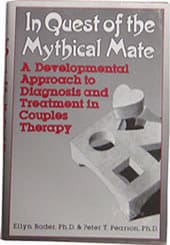
I’m feeling sad. After 26 years and 17 printings, our book “In Quest of the Mythical Mate” will no longer be available in hard cover. I’ll miss her. She really is like an old dear friend, symbolic as the first big collaborative project Pete and I did together.
I feel nostalgic about those birthing years. Pete and I walked, talked and worked together with creative energy and intense youthful enthusiasm to launch The Couples Institute and build our Developmental Model. Add to the mix writing the book about it. Then we juggled all that with the birth of our daughter, Molly, and the exciting first year of her life. We wrote the first two thirds in the year before she was born and the last third wasn’t finished until after she was a year old.
It has been a long time since I’ve written a blog specifically about The Developmental Model of Couples Therapy. It seems timely to summarize some aspects of our model that have truly stood the test of time.
Becoming an effective couples therapist is no easier now than it was when we started. It still means being incisive, decisive and quick to interrupt chronic negative cycles. It means being highly active without getting in the way of each partner stretching to develop new parts of himself or herself.
Supporting and encouraging significant change takes a lot of personal development from you. It isn’t just cognitive learning that allows you to incisively empathize with pain while confronting symbiotic belief systems like these:
1. “I’ve given and given all I can, now it’s my partner’s turn.”
2. “If you really loved me, you would read my mind, know what I want and give it to me in a timely way.”
3. “If you really loved me, you’d give up old significant relationships for me.”
4. “If you really loved me, you would want closeness and intimacy when I want closeness and intimacy.”
5. “If you really loved me, you would change your personality to please me.”
It takes you managing your own reactivity and smiling while you make tough confrontations.
Central to our model is the belief that couples relationships require energy, vitality and developmental growth from each partner. Too many partners try to maintain stability by demanding compliance and insisting on unnecessary sacrifice from one another. These relationships die as partners stagnate in conflict avoiding or conflict dominated relationships. Growth in the present is sacrificed in hopes of recreating the unconditional love they so badly needed when they were young.
In our Developmental Model the problems couples have are understandable and predictable based on:
1. The attachment style of each partner
2. The developmental stage of each partner and the relationship
3. The length of time they have been together
Within this framework, and with my online couples therapy training program, you can provide a clear roadmap of what good healthy development looks like and you can clearly explain how couples trigger one another, how they inhibit development and why they become chronically symptomatic. Yet, it is not a pathology model.
Understanding the Developmental Model allows you to work actively with partners to create differentiation-based moments in the office, while helping them embrace anxiety leading to growth. Couples who are stuck are unable to do that. They misinterpret differentiation and attack each other when differences surface. When they have very different desires, they think there is something drastically wrong. Sadly, they miss some of the most challenging growth possibilities as part of their journey to deeper love and vitality.
Pete and I define differentiation as the active, ongoing process of being open, vulnerable and authentic. This means each partner takes an active role in defining self in real time, expressing his or her thoughts, feelings, wishes and desires. This means managing existential anxiety that comes when there is disagreement and partners don’t want the same thing. In these moments there is an opportunity for greater intimacy and a risk of greater disappointment, but they are committed to activating themselves, being open, revealing themselves and managing ambiguity.
And no – couples won’t go there without your strong hand, leading, encouraging, supporting and confronting. This is the true joy of being a couples therapist!
The publisher is selling the new soft cover “In Quest of the Mythical Mate” for $48.95, but we’re pricing it at $42. If you would like to check it out, claim your copy now. Many therapists keep a copy in their offices to use the chart in the appendix. It includes a description of each stage including the unique developmental tasks of that stage and the developmental stalemate. Then it describes how to assess the stage and provides specific treatment suggestions for each stage. A very handy reference, indeed!

"*" indicates required fields
 We respect your privacy.
"*" indicates required fields
We respect your privacy.
Thoughts on Filling Your Practice (When things feel uncertain) I’m hearing this question from many therapists now about their practice: “It’s not just me… right?”
"*" indicates required fields