 We respect your privacy.
Three Principles for Disrupting Symbiosis in Hostile Angry Couples
Have you felt yourself become the target of a client’s rage, or caught yourself bracing against an interaction that felt more like a brawl than


Last month I attended the Evolution of Psychotherapy Conference, in Anaheim, CA. Their website identifies this conference as “The Premier Event for Psychotherapy Education.” And this particular one, their first fully live one since the pandemic, was especially anticipated. Another headline read, “Get ready for the best psychotherapy event in six years.”
I presented much of the time, so I wasn’t able to attend many other sessions. Instead of my usual “conference highlight” blog, I’m going to share a couple of general observations and then some highlights from my own presentations.
First, it really was wonderful to be back in person and see so many younger therapists eager to learn and share. The energy was palpable – and magnetic. Clearly lots of folks were excited to learn. People rushed to attend as many workshops and presentations as possible. Hallways, elevators, and restrooms buzzed with excitement and lively conversations. It reminded me of the first time I attended this conference and heard so many teachers whose texts I had read in my psychology courses. Then I had felt that I was in the presence of celebrities. And this time I was honored to be there as one of those teachers.
Juxtaposed against this happy, vibrant scene was the exhibit hall. At past meetings, the exhibit hall was filled with tables representing various approaches to psychotherapy, showcasing their work and providing attendees with opportunities to learn more. Then, booksellers, video demonstrations, researchers, innovators filled the room and again, conference attendees rushed from one display to another. It was a real smorgasbord of what was possible to learn.
This year’s exhibit hall was entirely different. Almost all the displays were large corporate groups recruiting therapists for their platforms. I spent as much time as I could there, speaking with recruiters like any other interested therapist might. They all wanted to talk about their company’s particular strong points: one pays more, another handles more marketing and pesky paperwork, another one gets you more clients or boasts of their speed getting clients. Not one single recruiter discussed the expertise of their therapists or the quality of treatment. And when I asked about this, I was told “Oh, we just believe any therapist is an expert in what they claim.”
Two years ago, I sounded an alarm about the corporate/private equity takeover of our field. What I saw in the exhibit hall told me that the takeover is no longer approaching. It is here. Now.
In this 3-hour workshop I addressed repair after infidelity. As an ongoing repetitive process, repair after infidelity requires a significant increase in differentiation. It is not a 1- or 2-time event. It requires strong leadership from the therapist and a willingness to hold clients in the tension they would prefer to avoid. I used this slide to illustrate the cycle of repair. I am glad to share it with you.
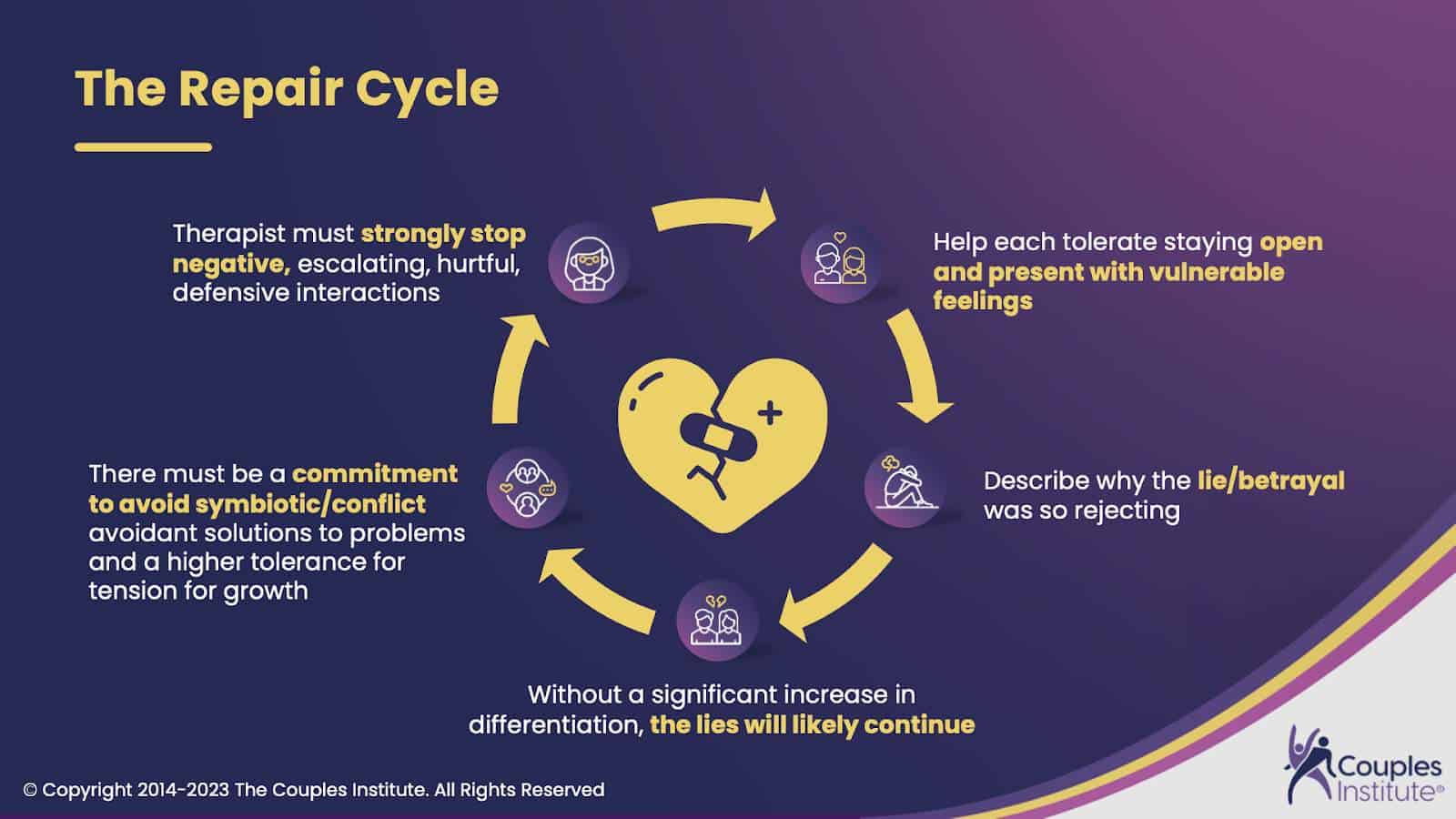
For my demonstration session I did a first session interview demo. Two therapists role-played an ongoing case. I was able to show the value of asking clients some very specific questions early in treatment:
Knowing the answers to these questions can help you determine how to move forward. For many couples, the dynamic created by an unresolved disillusionment remains cemented in what is painful now – and has been for many years.
Of course there were a couple of presentations on the hot topic of AI. In one talk, Marty Seligman suggested AI could essentially conduct conversations with the dead. He described putting a person’s body of work into AI and then asking a question about it. For example, “What would Freud say about X (a subject never addressed by that person)?” He used his colleague Aaron Beck as an historical example, and he was impressed by the way AI organized Beck’s thinking into coherent advice for Marty.
Finally, I’ll share these highlights from Marty Seligman’s keynote, which I loved. It was full of wonderful nuggets of learning based on his many years of studying both learned helplessness and positive psychology. He stressed how efforts towards well-being create even more well-being. His model called PERMA highlights 5 elements of well-being.
Combined, these all lead to a state of well-being. You can learn more about Marty and his work at www.authentichappiness.sas.upenn.edu
Overall, I came away from the meeting enjoying the stimulation of being back in person. It reinforced my commitment to building a strong community of quality professionals who do excellent work, support each other’s growth and cross refer and collaborate on cases when appropriate.
You can remain committed to quality, stand for meaningful progress for your clients and help t build alternatives to corporate domination!
I’ll end with an invitation to comment below. If you read something here that strikes a chord, write about it. Or if you attended the conference and have some other observations, those would be great, too.
ACT NOW
1. Mini-Intensives: High Impact Couples Therapy is a 4-hour course on January 19 that will redefine how you perceive couples therapy, and how your couples experience it. This revolutionary format works with all approaches, and we’re conducting a live Q&A session about it on Friday, January 12 from 9-10am Pacific. Click here to get the Zoom link to join.
2. Or click here to get on the waiting list for the Developmental Model of Couples Therapy Training, which opens briefly on January 20, with a special bonus for people on the waitlist.

Have you felt yourself become the target of a client’s rage, or caught yourself bracing against an interaction that felt more like a brawl than

Our dear friend and colleague Dr. Mark Brady was born at the end of July in 1946 and died at the end of July in

In my last blog post I discussed a couple where the wife came into therapy wanting transparency, especially around money and fidelity. She wanted more direct