


Daily Double Practice Guide
[Editor’s Note: This exercise for couples helps partners communicate to each other twice a day that they love, respect, value, or appreciate what they do

You ask your couple what they want to accomplish and you see their eyes drift off toward the ceiling.
You ask what’s motivating them and the silence gets heavy.
You ask what’s holding them back and defenses rise like shields in a medieval courtyard.
You’re likely thinking:
There has to be a faster, deeper way to get to what really matters.
There is.
And it comes down to three simple fill-in-the-blank lines.
You can use this with almost any couple or client, on almost any issue.
For couples the three questions would be:
I strive to create the kind of relationship that __________
So that __________
Even though __________
That’s it.
You can forget about handouts, worksheets, or complicated backstories.
Just three prompts reveal the dream, the drive, and the drag all at once.
Here’s how it could unfold.
“I strive to create the kind of relationship that makes us glad to be together, the kind where we can communicate and solve problems.
So that we actually look forward to being together at the end of the day.
Even though my anger and resentments still get in the way.”
In one breath, you’ve uncovered:
That’s the entire arc of a lot of therapy in three lines.
You can narrow the focus for couples:
I strive to be the kind of partner who __________
So that __________
Even though __________
It might sound like this:
“I strive to be a partner who can be depended on, who’s supportive and involved.
So that we can become a team traveling through life together.
Even though I’ve always believed being independent and self-sufficient was the only way to survive.”
That last line – “even though”– is the money line.
It names the invisible hand that’s been steering the relationship from the shadows.
Once named and revealed, it loses a lot of power.
When expressed it becomes more accessible.
What if you used this exercise for yourself?
I strive to be the kind of therapist/coach who __________
So that __________
Even though __________
Maybe it’s:
“I strive to be the kind of therapist who challenges clients toward growth, not comfort.
So that they can build marriages rooted in strength, not dependency.
Even though I sometimes fear they’ll see me as too tough, too demanding, too directive.
Every time you complete this exercise, it’s like consulting a compass to clarify your route.
You see the paradoxes that drive both you and your clients.
And often it is paradox, not pathology, where transformation begins.
Because therapy is more than giving information even though information can be crucial.
It’s often about imagination, the courage to picture something better and face what stands in the way.
These three questions create a bridge between the dream and the drag, between who you are and who you could become.
Clients get the clarity to identify where they strive to go and the resistance that keeps them self-protectively stuck. And sometimes, that’s what it takes to continue to change.
So in your next session, instead of asking for goals or complaints, pull out these three lines.
Have your couples fill them in at the same time on paper.
Exchange their responses.
You might even first ask them what they thought their partner wrote.
After they read their own responses, stay quiet after the “even though.” And let the silence do the heavy lifting.
Watch as clarity begins to unfold.
Now you’re better prepared to help them live truer, more authentic lives.

"*" indicates required fields
 We respect your privacy.


"*" indicates required fields
We respect your privacy.[Editor’s Note: This exercise for couples helps partners communicate to each other twice a day that they love, respect, value, or appreciate what they do

[Editor’s note: this love letter went to our email list on Valentine’s Day and it seemed good enough to give it a permanent home on
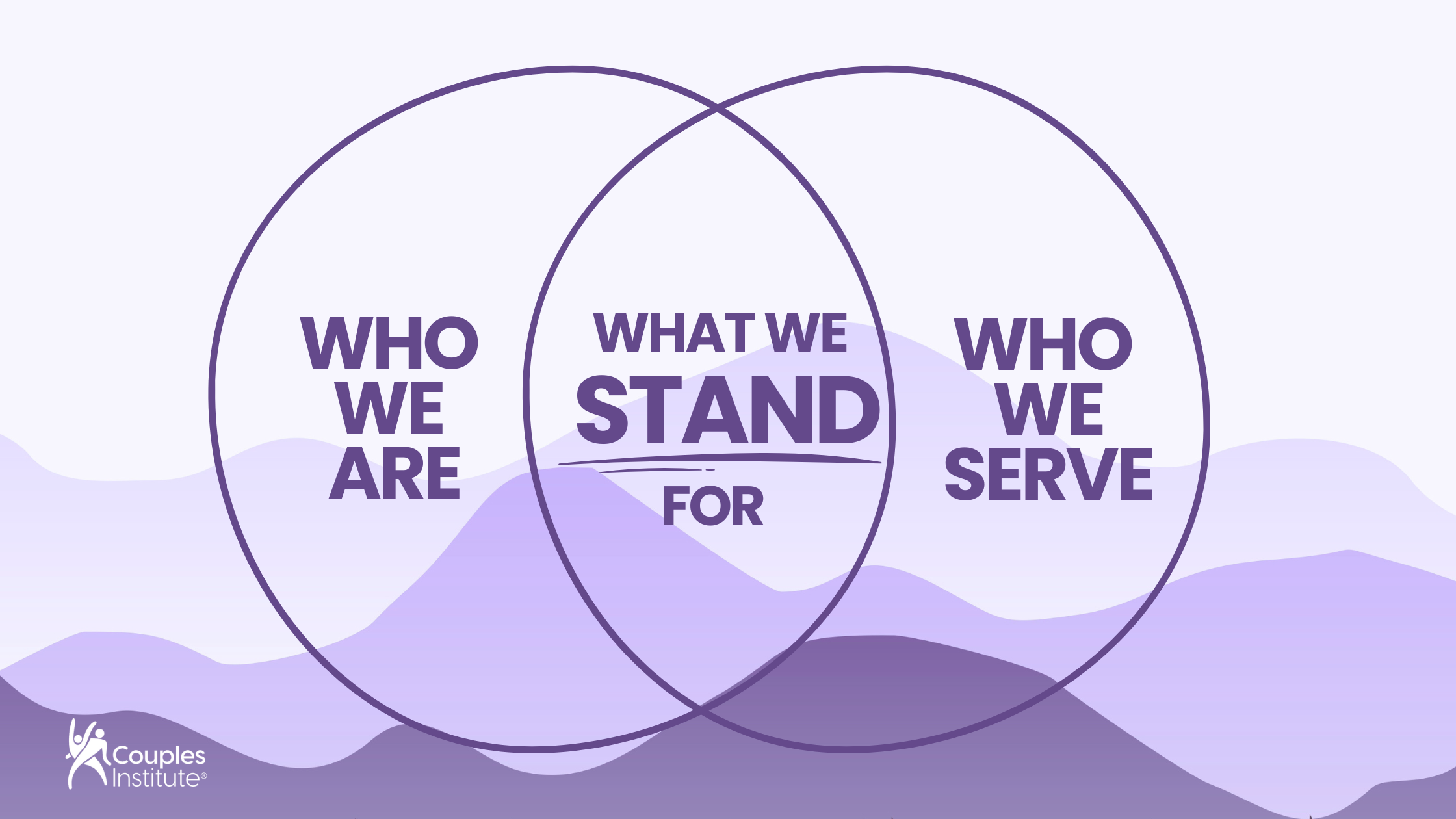
As we look into the New Year, I want to share with you very clearly what Couples Institute stands for, now and always. Most of
"*" indicates required fields
I love this exercise! So simple, clean, and yet powerful. Thank you!
Thank you for the gold, Pete. Leading the couple into a strong state right before the exercise will probably increase their courage to complete each of the three lines strong and from a deeper truth. And of course, leveling up my own state before the session helps me lead them. Plus the shaking, dancing, breathing or whatever resource we use is fun. I will try the state + sentence completion at the next opportunity. I much appreciate you sharing this growth option.
You are the best! Thankyou!
I love the “ imagine” part and then the “ focus” of how to get there and what the individual is willing to contribute to that realization ( or not)!
Each time you or Ellyn provide wisdom, you knock it right out of the park with clarity and direction! Beyond blessed to be part of your community. Thank you
This reinforces my therapeutic approach. Grateful
This is gold.. thankyou
This is great Pete. I was wondering what you do when a couple or a partner goes into blame with the question ‘even though’? I can see some of my clients saying something like ‘it’s hard because my husband (wife) makes it difficult for me to be kind…..!’
Absolutely, you hit on the scary prospect for me too, Leanne. Maybe that last statement could be changed to make an
Istatement: “Even though I…”That would ensure it is a statement about themselves — if only their seemingly-necessary reactivity. Then there’s a gap between stimulus and response that might be explored. You are inspiring me to brainstorm some responses:
“I guess it really feels like you have no choice.”
“It would be really hard to meet that difficulty with something else.”
“What would it be like to try to meet that difficulty with something else?”
“What is your vulnerability that you are shielding in that moment?”
“What do you imagine your partner is feeling, that makes them difficult in that moment? What is the difficulty they are feeling?”
“What is their vulnerability that they are shielding?”
I don’t have a one-shot response, but I actually like the word “difficult” as an opening to the stuckness.
This is the most powerful blog I’ve read all year! So deep and on point! Thank you Pete! Still remember your geese teamwork you tube video and how inspiring that was toooooo
I’ve been tying this with my clients thanks to Pete’s drop in session. Very enlightening!!!
I like this exercise and I also see that it only works with people who are very much in touch with their inner life, who can self reflect and articulate well. I’m wondering, how you would use it with couples who are not that self reflected? Would you have to work on that first, before you could use the exercise?
love this too! direct, clear and clean, says to all- let’s be real, and lets be real now! Thank you
I love this and will abolutely try it. Thank you!
Straight to the point – great
I have found that quite a few couples get stuck on ” eventhough…..’ reluctance to admit or acknowledge own role ?
Great prompts
Will definitely use this in my practice
Beautiful. Simple. Pithy.
I’ve been trying to buy the quest kit at $197 for 20 min. the payment site keeps sending back to beginning. Help!!!
Love that you turned this onto “us,” as clinicians…. I needed this prompt for reflection today. Thank you!