



Neuroception: Why We React Before We Think
Our dear friend and colleague Dr. Mark Brady was born at the end of July in 1946 and died at the end of July in

In 1941, Sławomir Rawicz did the impossible and became the first man to walk out of a Siberian labor camp and survive.
He braved frostbite and wind blindness, surviving on leather and melted snow. He crossed the Gobi Desert in summer heat that cracked his skin and shrank his tongue in his mouth.
And 4,000 miles later, he crossed into British India and … just kept walking. Because that was the only thing left he knew how to do.
He survived because he was willing to question every assumption about where he was and where he needed to go.
I think we are at a moment like this in the arc of human history. Including in the profession of therapy.
Here's what I mean.
Far too often, I see the following problem in therapy:
You have a client who keeps coming back to the same problem. They fight the same fight with their partner, they’re lonely, they’re resentful, they’re hurt.
You help them make sense of it, process the pain, understand the pattern. And months later, you're hearing roughly the same story with slightly different details.
When you work with one person in a two-person problem, empathy alone becomes a kind of trap. Because you're essentially looking at the relationship through a window that only opens on one side.
But relationship distress is inherently relational.
It is created by patterns that exist between two people – patterns that are often invisible when you only talk to one partner.
This is how well-meaning therapy can accidentally make things worse.
Your client leaves sessions feeling more certain, more justified. The other… well, we don’t know what’s going on with the other partner. We only hear the story from an unreliable narrator.
Even if you’re working with just one partner, you can still use a relational lens. If you don’t, several things tend to happen:
In some situations, individual therapy can unintentionally intensify polarization. A partner may feel increasingly justified, while the other becomes more defensive or withdrawn.
As one clinician described, the influence of individual therapy can be quite powerful – shaping how one partner shows up in ways that affect the entire system.
Again, this is not about doing something “wrong.” It reflects how much impact a therapist’s perspective can have.
Step 1: Get curious about the other half of the picture.
Step 2: Don’t withdraw empathy, but experiment with relying on it slightly less. When you focus on curiosity, you can help your client soften an increasingly airtight story about their relationship.
When you see individual complaints through a relational lens, you’ll start to notice important factors:
When this perspective is introduced, you can move therapy forward. You can create important shifts from certainty to curiosity, from blame to exploration, from repetition to the possibility of change. And ultimately, to hope for a better relationship.
Rawicz survived because he was willing to question every assumption about where he was and where he needed to go. He didn't have a better map. He just stopped trusting the one that was only showing him half the terrain.
That's the shift we're talking about.
Thinking relationally does not require both partners to be in the room. But it does require a different way of listening – one that holds both the individual and the relationship in mind at the same time.
In Part 2, we'll get into the specific ways you can start thinking relationally with individual clients – practical shifts you can make in session, without needing both partners in the room.
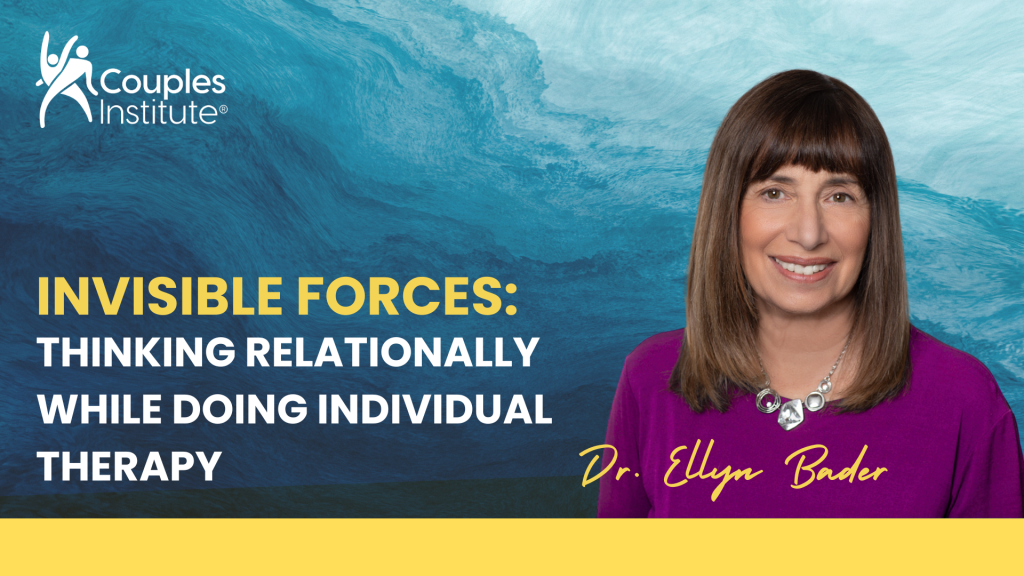
If you’d like to see how I think about these dynamics in real time, I invite you to join me for a live training.
Invisible Forces: Thinking Relationally While Doing Individual Therapy
📅 June 8
⏰ 11am-12:30pm Pacific
In this session, I’ll walk through a clinical example and show how I work with relationship dynamics even when only one partner is in the room – how I listen for patterns, think developmentally, and respond in ways that support growth.




"*" indicates required fields
 We respect your privacy.
Our dear friend and colleague Dr. Mark Brady was born at the end of July in 1946 and died at the end of July in

In my last blog post I discussed a couple where the wife came into therapy wanting transparency, especially around money and fidelity. She wanted more direct
My dad has a PhD in psychology. Which sounds like it should come with a disclaimer. Like, “results may vary” or “side effects include being
We’re building a free training for you about fighting couples. Would you take a moment to tell us what’s been most difficult lately?
Answer now