
COMBAT OVER CLUTTER
A live 3-session training for therapists whose clients say "I can't live like this." with Dr. Pete Pearson
Somewhere in the Twilight Zone, is a version of couple’s work where “the fight about clutter” takes only one session.
Couples come in. You help them make an agreement. They high-five about it. You collect your fee.
Your protocol sticks, they live happily (cleanly) ever after. NEXT.
However, I’m willing to bet a pretty penny you do not live in that universe.
We polled our community of therapists and 73% of them said their couples report household clutter is a significant issue!
SEVENTY-THREE PERCENT.
For a problem that is, on paper, an organizational task.
But if clutter were actually about clutter, the book The Lifechanging Magic of Tidying Up would have solved that problem forever and no one would fight about it. Ever again. And therapists everywhere would have their Tuesday afternoon free.
But the book did not solve the problem.
You do not have your Tuesday back.
You keep hearing every version of it: “He is completely oblivious to clutter.” “She thrives on chaos, I swear.” “They are a total pack rat.” Or even, “I feel paralyzed by clutter. I don’t know where to start.”
Each of these statements are a symptom of a much deeper issue.
CLUTTER IS A “LAMPPOST PROBLEM”
There’s an old joke I like to tell.
A man is on his hands and knees under a streetlight at midnight, scouring the pavement. His neighbor walks up. “What are you doing?”
“Looking for my keys.”
The neighbor gets down and helps him search. Ten minutes. Nothing. Finally the neighbor asks, “Are you sure you dropped them here?”
“Oh, no,” the man says, and points down the block into the darkness. “I dropped them way over there. But the light’s so much better here.”
That is what most couples therapy does with clutter.
The mess is the lamppost. It’s visible. You can practically photograph the problem, so that’s where everyone starts. Pointing fingers, trying to make agreements, buying Good Housekeeping’s “Ultimate Checklist for Decluttering your Home Forever.“ All these tactics have couples looking in a well-lit spot where the answer has never once been.
The solution is down the block, in the dark. And I have spent over 40 years learning to walk couples straight into the dark part of the street. We work someplace other than where they are pointing to the pain. This is how we come back holding the keys. When you learn to do the same thing, everyone wonders how the heck you did that. And then they tell their friends. (I hope you’re ready for some referrals!)
ABOUT THE GUY WHO WALKS INTO THE DARK
If we haven’t met before, I’m Dr. Pete Pearson, the co-founder of The Couples Institute with my wife, Dr. Ellyn Bader. Together we created the Developmental Model™ of Couples Therapy, a framework thousands of therapists in 81 countries are using when they need results. I’ve spent 40+ years helping couples, and roughly the same amount of time teaching therapists and coaches how to help clients “find their keys.”
But let’s take it a step further. I have worked with Navy SEALs and Army Rangers. Members of the most elite teams on the planet. Men trained to carry 600lb logs named Old Misery. Men who would never let a teammate down on a mission behind enemy lines.
And, shockingly, their wives sat in my office and said again and again, “I can’t depend on him.“
He forgot the milk. He skipped the dry cleaning.
He never thought of marriage as a team.
Sit with that. If elite, life-or-death teamwork doesn’t automatically transfer to a shared kitchen, what chance does your chore chart have? None. Zero. Somebody has to build the team. And building that team is the beating heart of what you will learn in our time together.
“Thanks to you, I feel inspired to continue to work with the most distressed couple I’ve ever worked with in thirty years.”
– Madeleine Campbell
“Thank you so much for a wonderful and insightful workshop. I now know the “thing” I missed with my clients/couples was building their motivation to work together as a team before we do anything else.”
– Loretta Watt
THE PSYCHOLOGY OF THE COMBAT AGAINST CLUTTER
In the opening scene of the 90s arcade game, Mortal Kombat, the title card flashes “Choose Your Fighter.” And couples do just this.
One chooses criticism, because they feel like it’s the only tool that has ever produced change. The other chooses weaponized incompetence, the strategic shrug of “I just don’t see mess like you do.”
Both of them are in pain. Both of them want relief. And neither one will retire their fighter. So the fight about the cupboard doors always being left open becomes a fight about control. Respect. The invisible mental load. Who has to change first.
If you aim your interventions at the mess itself, every chore chart and checklist will sail right past the actual fight. Which is why couples keep coming back and you keep leaving those sessions with your jaw tight and that thump in your brain that pleads, what am I missing??
Turns out, all you’re missing is the location of the fight.
WHY THIS COURSE IS A STUPID IDEA (AND ALSO WHY IT’S NOT)
Nobody on earth is shopping for a clutter course. We know. Of every issue a couple can raise, this is the most basic, should-be-drive-through, one-session problem. So when 73% of you tell us your couples are STILL fighting about it, that tells us there are two layers of clutter in that home: the piles on the counter, and the relational clutter piled underneath it. The first layer has a $17 solution at the closest bookstore. The second layer is why they’re in your office.
I picked the most basic entry point so you can learn to clear both layers at once. You can learn how to use this “simple problem” to do astoundingly meaningful work. You can practice this method with the simplest fight, so you can use it later with the hardest one. The principles you learn will apply just as much to clutter as they will to “should I stay or should I go?”
THE FORMAT
Week 1: The live role play.
I’ll work with a “couple” locked in combat over clutter (you can volunteer if you’d like to roleplay as one of your clients). And then I’ll stop the fight and I’ll show you what I just saw, what I’m about to try, and how to do it.
I’ll interrupt with something like, “Right now I am not trying to solve the clutter. I am trying to help you both see the pattern that takes over when clutter appears.” And then I’ll show you how to stop chasing insight and run a small experiment instead. Because insight is where most therapy stalls, and experiments are where couples actually change.
Look — the licensing boards think you learn this work from a lecture and a quiz. But you don’t learn to drive the Indy 500 by watching a movie about cars. You learn by getting on the track, hitting the wall, and adjusting. This is the closest thing that exists to riding shotgun with someone who’s driven this track for four decades. And you’ll have the freedom to yell “STOP! Why did you do that?” at any moment. And I’ll actually answer.
Week 2: The price of change.
This is the part that no clutter solution on the market even knows exists: the FOUR secret battles hiding inside every clutter fight. The couple’s battle with The Difficulty of Life. Their battle with each other. And a private war raging inside each partner – “I will not be blamed, controlled, or humiliated” vs. “I want us to be better than this.” If you don’t address all 4, you’ll be hearing about the cereal bowl on the counter and the Impossible Cleanliness Standards forever. But address each of them and you will be the hero your clients are desperate for.
You’ll also learn how to hand responsibility for change back to the couple without one single “well, what do YOU think you should do?” And you’ll get the fill-in-the-blank prompt I give every therapist I coach. It may turn into your North Star for the rest of your career.
Week 3: Your cases.
Here’s what happens in a consultation with me. Bring the couple that makes you chug a coffee before you can face them. Tell me what you’ve tried, where it died, and what you’re scared of. And I won’t give you a single script for what to do. You’ll forget a script the second a session starts to get away from you. Instead, we’ll run your case through the principles we’ve been focusing on, addressing the 4 secret battles under clutter, and small experiments that lead to success.
After you try what we worked on together, I don’t want to hear how it went. I want to hear what you learned. I ask that question after every consultation I do. Because that question is the difference between collecting techniques and actually applying what you learned. It’s the question that ensures you make the most of your investment.
“There are things you did in those role plays that were incredibly change-making” – Jo Moller
CALL DATES AND TIMES
August 4, August 18, September 1, at 11 am-12:30 pm Pacific
BONUS HANDOUT: THE CHART
I need to tell you about The Chart (no, it’s not a chore chart).
I’ve mapped the 5 things that must be present for a couple to actually change. This took forty years to build and I’m sharing it with everyone in this course.
What will make you fall in love with the chart is this: it works in reverse too. When one of the 5 is missing, the session has a very specific feeling. Each missing piece produces a DIFFERENT feeling. And that feeling will tell you which aspect is missing. So the feeling itself becomes a diagnostic and tells you where to work next.
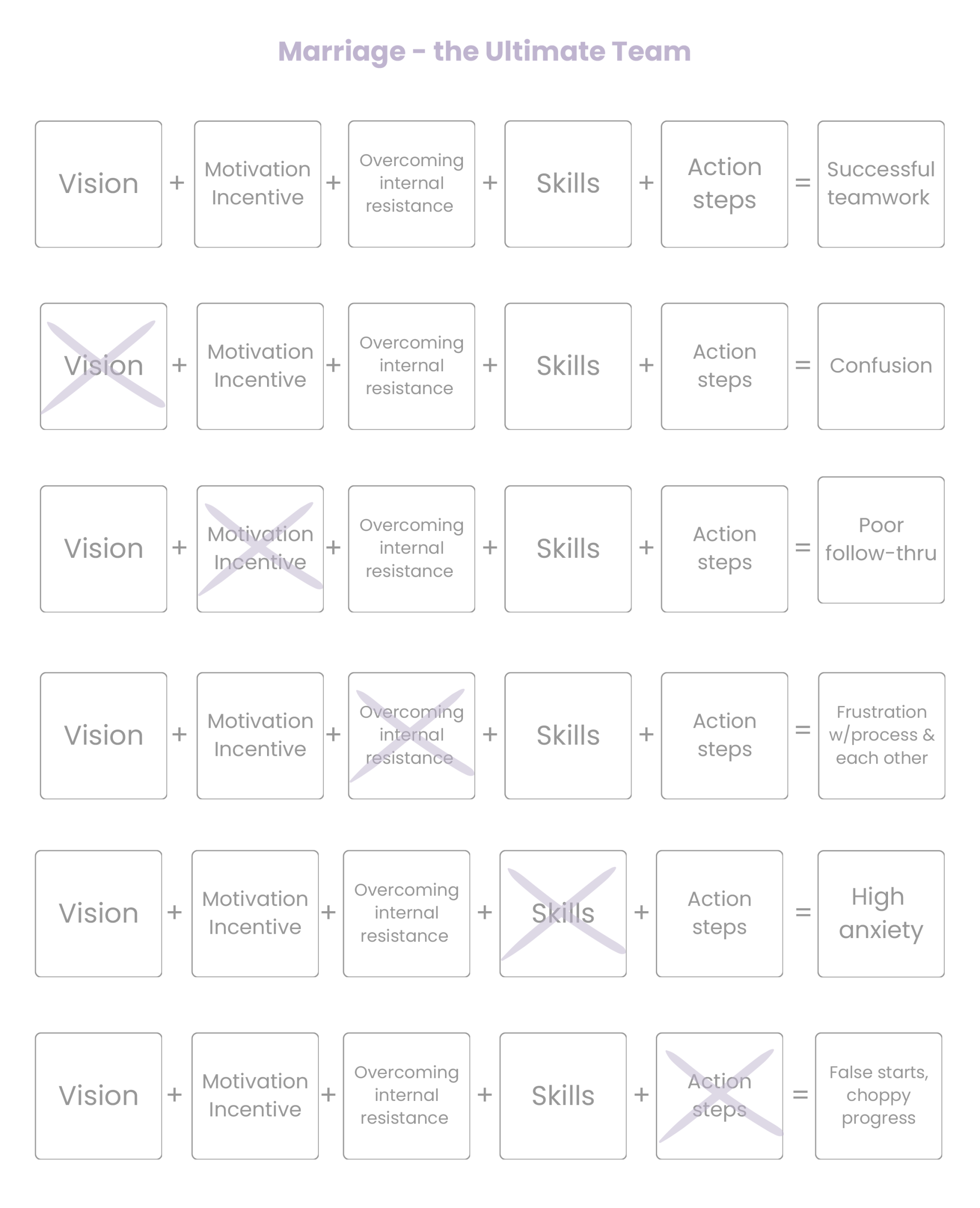
It’s the same chart I’ll be working from in the role play, so you’ll watch it operate before you ever fill one in. Then you can practice with the topic of clutter, so you’re fully prepared to use it with fights about money, sex, kids, conflict styles, and more.
“I have Gottman and EFT really well manualized and it has never been enough. Because if you don’t have all the other stuff we’ve been learning here, your couples will go away with a bunch of skills they won’t pick up because they don’t have the motivation or the vision. I used to always feel like such a failure, because I knew the Gottman stuff so well and I don’t see it doing what I need it to for my couples.” – Lindsay Rayball
"BUT MY COUPLES DON’T FIGHT ABOUT CLUTTER”
Then I’m impressed you made it this far. Here’s the important thing: this course gives you principles, not interventions. These principles work on the hostile couple. The avoidant couple. The motivated partner dragging the immovable one. The individual client whose partner won’t come in. Clutter is the demonstration model because it affects so many relationships and you can watch the method work.
If your couples don’t fight about clutter yet, they probably will. And with lifetime access to the material, you’ll be ready when they do.
WHO SHOULD ABSOLUTELY NOT SIGN UP FOR THIS
This is NOT for you if you want to get better at “cleanup on aisle four.” If the surface-level fix is your whole goal, save your money. Real Simple magazine has an edition on clutter for $10. And it has pictures.
This is NOT for you if you believe you are the primary force of healing in the room. This whole model builds a team out of the couple, and it’s the team that does the repairing, often better than we ever could.
This is NOT for you if a couple slowing your momentum with resistance makes you want to work harder while they work less. (Okay, actually — if that one stung, this might be exactly for you.)
It IS for you if you’re tired of dragging couples across finish lines. If you suspect the fight in front of you is smoke from a much older fire. And if some part of you — the part that got into this work in the first place — wants to be the change agent who walks into the dark part of the street while everyone else is still searching under the lamppost.
Combat Over Clutter: a 3-week live training with Dr. Pete Pearson
August 4, August 18, September 1, at 11:00 am-12:30 pm Pacific Live on Zoom

Here's everything you get:
- Three Live Sessions with Pete: role plays and live case consultations on YOUR stuck couples
- The Psychology of “Chore Wars” – an in-depth look at the inner conflicts that make clutter such a hard issue to tackle
- Pete's "7 Steps to Change Your Partner" Handout – built so a partner wants to change instead of feeling coerced into it
- The Chart – the clarifying tool that lays out 5 aspects of successful change, and what it feels like when you’re missing one of them
- The Full Powerpoint Presentation, yours to keep
- Replays of Everything — though read the next paragraph before you plan to lean on them
A word on showing up live: the recordings will capture every bit of the teaching. What they cannot capture is me answering a question about YOUR couple. Or you raising your hand for a role play. The teaching is recordable. The consultation is not. Come live.
The guarantee: attend the first session. If you don’t walk away with at least one thing you’ll use with a couple that same week, email us and we’ll refund every penny. We can offer that because I have been helping change couples with this material for decades. The risk here is ours, not yours.
And the math, since you’re a professional and this is a professional decision: one couple who stays in treatment because you’re getting traction with the Dishwasher Fight of The Week covers this training several times over. That’s before you count every couple you can help after them. Registration closes on August 4 — before the first session, no exceptions, because I will build each session around the needs in the room.
Frequently Asked Questions
Do I need training in the Developmental ModelTM to keep up?
No. Everything is taught from the ground up using the chart and the live work. If you already have Developmental Model trainingTM, you'll see where this plugs in. If you don't, this is honestly a very good doorway into it.
Will I be forced to role play?
Never. Volunteers only. There's real gold in volunteering, but if you’re an introvert, you’ll still get plenty. Nobody gets called on when they aren’t ready. You have my word.
What if I can't make a session live?
You'll get the replays with lifetime access. But hear me: the teaching is recordable, the consultation is not. The replay can't answer a question about your couple. If you can only make one session live, make it week three.
Is this CE eligible?
No CEs for this one. We’d have to charge extra for that and we’d rather pass along the savings to you.
I work with individuals, not couples. Is this wasted on me?
No, the private war that’s waged inside of someone shows up in individual work constantly. Many of these principles apply to any client protecting themselves with the very behavior that's hurting them. But I'll be direct: the live work is couples-focused. If you never touch couples work, this is a rich elective rather than a core course.
Is there a guarantee?
Yes. If you don’t gain at least one powerful, practical insight that makes your work with couples easier, I’ll refund you in full. No fine print, no hassles – just email me, and I’ll return your money.
And honestly? If you walk away without learning something new, I’d love to talk to you – because that would mean we need to create an entirely new training together.
How big is the group? Will my case actually get consulted on?
Case consultation spots are capped to the time we have together. If you order by July 26 you can email me to be part of the roleplay in week 1.
What's the refund policy?
Attend session one. If you don't walk away with at least one thing you'll use with a couple that same week, email us for a full refund.
How much homework between sessions?
One case reflection before week two — five prompts, maybe twenty minutes — plus whatever experiments you choose to run with a real couple. The experiments are where the learning lives. Reading won't be your problem; trying will be your assignment.
One Payment of $210
- 3 Live Calls with Dr. Peter Pearson
- Lifetime Access to the Recordings and all the Materials
2-Payments of $105
- 3 Live Calls with Dr. Peter Pearson
- Lifetime Access to the Recordings and all the Materials
2nd payment will be charged in 30 days.