
Help Couples Communicate
Learn a Breakthrough Method For Resolving Conflicts
and Building Deeper Emotional Connections
The "Trigger-Fight-Blame" Cycle Is Real
Growing up, most of us didn’t learn how to collaborate with an equal. We were in situations with parents, teachers, coaches – all hierarchical relationships. We learned to fall in line and quiet the parts of ourselves that created conflict, or we learned that yelling and being combative were the ways to be heard.
Couples take these patterns into their relationships and then feel incredibly uncomfortable when their partner wants something different than they do. They dance around issues, fighting or ignoring them until the tension is so unbearable they come to you and expect you to wave a magic wand and fix it.
In our decades of observing, experimenting, practicing, and refining, we discovered a counterintuitive way to structure sessions that prevented many pitfalls where even the best therapists were getting stuck.
A Transformative Realization About Couples – It's Deeper Than "We Can't Communicate"

Drs. Ellyn Bader and Peter Pearson, co-founders of The Developmental Model and Couples Institute, have spent over four decades helping couples create breakthroughs and training therapists to become exceptional worldwide.
After helping couples “problem solve,” Ellyn realized that even if you ”fix the problem” you’re still not solving it!
What matters more than anything is how couples talk about the problem. How they deal with it together, how they listen to one another, and how they reveal themselves.
THAT is what matters the most.
It’s what will make or break most relationships.
Once Ellyn shifted her work to helping couples develop internal emotional muscle, everything changed.
So Pete and Ellyn mapped out every step of this process, practiced it with hundreds of couples in workshops, and then made it possible for other therapists to repeat this system. And that’s how The Initiator-Inquirer was born.
Get The Change Lab
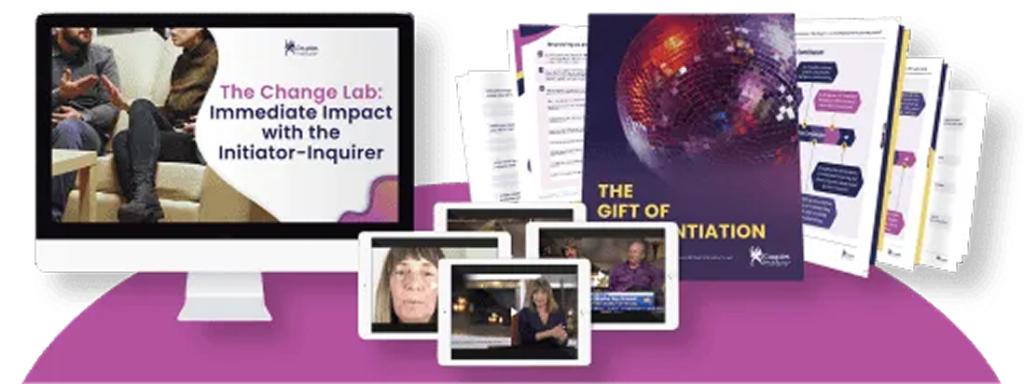
When You Help Couples Develop Internal Emotional Muscle, Everything Changes.

Surprisingly, when Ellyn started saying to couples, “we’re going to take solving problems off the table,” they felt relieved.
So if we’re not solving their problems, what are we doing?
We are building emotional capacity that supports them functioning as a team.
You might say to a couple, “You’ve had no practice being a team – until today. I’m going to get you thinking differently about how to talk about issues. You’ll learn to accept conflicting parts of yourself and your partner. You’ll learn how to sit in the tension while you discuss charged topics without rushing to premature decisions. You’ll develop the skills to collaborate. You’ll learn to talk more deeply and have more productive conversations. And ultimately, you’ll learn more about yourself and your partner. Are you on board?”
This approach comes with a bonus – problem solving often naturally happens after both partners feel understood and can discuss options.
Working from this framework, called the Initiator-Inquirer, means clients feel like they’re getting the change they came for.
When You Master the Initiator-Inquirer Method, You Will Transform Couples’ Communication Skills and Get Off
The Merry-Go-Round
If you’ve found yourself on the Not-So-Merry-Go-Round of slipping away from the core issues, getting dominated by clients, and unsuccessfully imploring clients to come forward, your best bet is to go way back.
Think kindergarten.
The Initiator-Inquirer process shows you how to remind clients of one very crucial skill they learned in kindergarten: taking turns.
It may sound simple, but it’s profound. When clients really learn how to take turns listening (inquiring) and talking (initiating), it helps them understand one another.
Equally important – it helps you understand exactly where they’re stuck and how to better help them.

If you take “negotiation” off the table and focus on helping clients understand one another, their ability to solve problems skyrockets – with or without you. And don’t we all want clients practicing their new skills outside of sessions?
That’s what’s so powerful and profound about this process. It helps any couple, no matter their presenting problem, eventually learn to resolve their own issues without drama, fighting, or withholding.
It also supports both partners working at the same time, removes you from the middle, and uses everyone’s time much more effectively.
Sounds like a bold promise, but I’ve seen it happen again and again, as have thousands of therapists I’ve trained around the world.

Using The I-I with
Hostile Angry Couples
If you have highly reactive couples, your best shot at being successful out of the gate is to spend a dedicated session setting them up for this process. While it might feel too boring or too structured, one session is a small price to pay for many future sessions of connection, growth, and success.
These are the couples who need the most structure. A great feature of this process is that it gives you more permission to interject, butt in, and change direction quickly. And once they start to internalize the skills, your sessions go much better and the couple feels like your sessions are deeply meaningful.

Using The I-I with Conflict
Avoidant Couples
Conflict avoidant couples have a long history of avoiding truth telling and truth listening. No one ever taught them that conflict is normal and human – and could propel them forward.
When you use the I-I to encourage a client to bring something up, you’re stopping their passivity and inspiring both partners to be engaged. This process doesn’t let one partner tune out and ignore the other. It puts healthy pressure on the couple to show up – and that risk taking has the capacity to raise the bar to where growth happens in a conflict avoidant system.
Confidently lead your sessions, get out of the middle, and get traction with your toughest clients...
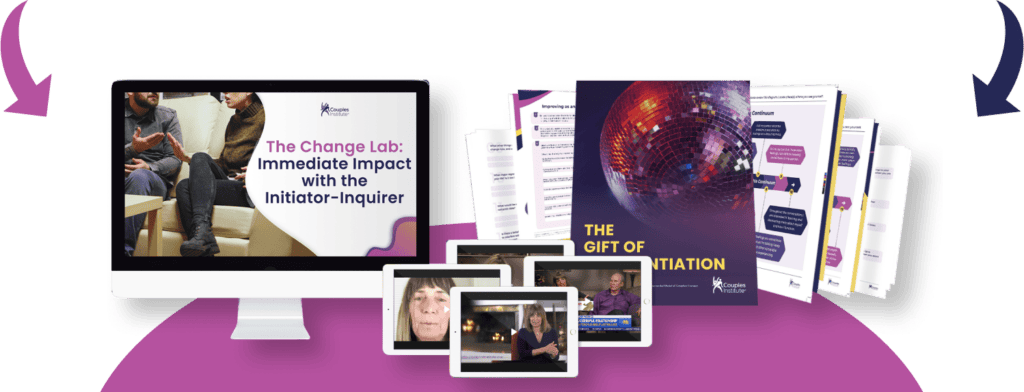
Here’s What’s Included...



NEW! Live Guided Practice Session with Trainer Cathy Carr. You’ll watch Cathy model how to introduce the Initiator-Inquirer the same way she presents it to people in my year-long training. Then you’ll step into breakout groups and role play with colleagues, so you can practice getting the words out in a supportive practice environment.
You’ll also learn to...

Teach clients to delay gratification so they’re not demanding you attend to each of their needs every session.

Increase their ability to manage reactivity and tolerate anxiety (this is the magic wand I teach every therapist to wave over their clients).

See very clearly where each partner is breaking down and give them the necessary skills to move forward while you get out of the middle.

Work with both people at the same time so no one complains about being left out or accuses you of taking sides.

Talk about issues in a way that helps each person know and own their part.

Strengthen clients’ ability to have productive conversations without you.

Get permission to intervene in a way that clients don’t feel controlled or shut down.
Improve Your Clinical Technique and Skill with Couples
In addition to getting video training and handouts, you'll also learn...
- The “6 Word Remote Control” to rewind and recover any time this process goes off the rails
- Tips to coach someone who has trouble staying in the inquirer role
- How couples can discuss charged topics without rushing to premature decisions (when this happens, usually they’re not happy about the decision anyway)
- How clients can accept conflicting parts of themselves and their partner
- Ways to develop the skills needed for collaboration, growth, and healing
- A proven framework for couples to communicate
- How clients can use this process to be more of who they want to be at their core
You Can Even Look Over My Shoulder During An Actual Conversation Using the Initator-Inquirer Process
This process works with money issues, affairs, parenting issues, explosive fighting couples, extreme passivity, and even clients with narcissistic tendencies.
That’s why I’ve included several roleplays that show you exactly how this process unfolds with some of the toughest kinds of problems.
Learn all about the Initiator-Inquirer, including…
Exactly how to describe the process to your couples, including a step by step description of each role
What you can be doing and what to listen for during the process
What challenges to notice
Why it’s still successful if either partner breaks down, and how that can still create meaningful progress
3 options of what to say and do when someone is struggling in their role
What to think about or point out afterwards
How to steer the questions back to ones that really matter
A demonstration of a safe and comfortable way to give clients a taste of the process
Hear What Other Therapists Think About The Change Lab...

“WOW! I’ve just finished an AMAZING session with a couple who are big on blame and defense. I used the handout and got their buy-in. They worked on a parenting issue and reached a beautiful moment where the inquirer filled with tears as the Initiator described his feeling of loneliness, in seeing her tears he also teared up, and they held eye-contact as I coached them not to rush away from this moment. I was so delighted when she said afterward, ‘that was really hard but I really like this process.’”
- Fiona Daly, Psychotherapist, Wicklow, Ireland
“This is absolutely brilliant! I used your process with two couples online last week and it worked like a charm!”
- Marian Meade, RN Psychotherapist, Canada


“This truly transformed everything in my practice. It took me a while to be able to get myself out of the middle, but I can’t imagine ever going back to that way of working. I love how Ellyn says if you are a therapist who loves to be front and center, you won’t like this which is so true. I am so thankful that I made the shift and my clients are too!”
- Barbi Pecenco, LMFT, Newport Beach, CA
“Even though I have been using the I-I for some time now I just learned much more. One of the things I love about it is the way we can really go deep with our clients and get them out of their reactivity. This call emphasized to me how important it is to see the process of HOW someone initiates and help them in that place. So many gems!”
- Janae Munday, LCSW, Arizona


“It continues to emphasize for me how easily the therapist might be pulled into a couple’s dynamic without realizing it. Having examples of sessions and how this can occur makes it extremely practical. Terrific session. “
- Linda Clarkson, MS, LPC, Georgia
Here's Everything You Get In The Change Lab for Couples…
Module: 1
Module: 1
Overview of the Initiator-Inquirer Process
- 4 principles of a formal setup of an I-I
- Tips on effective initiation
- Tips for effective inquiring
- 8 key things the Initiator-Inquirer accomplishes
- Addressing frequent questions about empathy, soothing moments, knowing when a couple is ready, who the I-I is appropriate for, and who to avoid using the I-I with
- Presentation Slides
Module: 2
Module: 1
Structuring Effective Initiation and Inquiring
- 9 common challenges in using the I-I so you can anticipate what you’ll hear from a client and not be caught off guard
- What to do when an I-I is “unsuccessful” – there are surprisingly rich possibilities that lay in these moments to make it a success
- Common breakdowns in the Initiator and Inquirer role – knowing these helps you be prepared for pushback from your clients
- The capacities that are developed and strengthened by each role
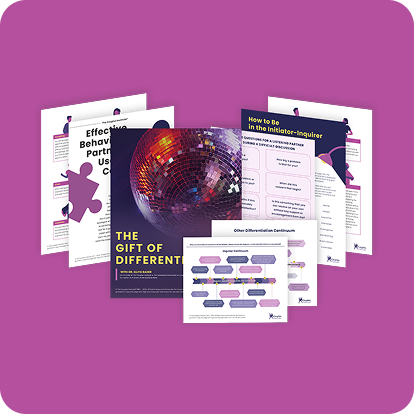
- The Gift of Differentiation, a handout we use with all clients
- Initiator-Inquirer Demonstration
- Initiator-Inquirer Exercise
- Common Misconceptions During the I-I Exercise
- Presentation Slides
Module: 3
Module: 1
How to Introduce and Set Up the Initiator-Inquirer
- Positioning the I-I as a way to help clients build emotional muscle (self and other-differentiation) so they can collaborate effectively and get through tough stuff together
- How the structure of the I-I paves the way for deeper work (and how this supports you even if you like to work from intuition)
- A demonstration of an I-I with a husband who had an emotional affair with a coworker
- Initiator Continuum – enables clients to identify where they are and where they want to be
- All-Purpose Questions for a Listening Partner to Ask during a Difficult Discussion
- Improving as an Effective Initiator
Module: 4
Module: 1
Initiator-Inquirer Role Play
- Video demonstration of an I-I with a real couple
- How to use normal anxiety to inform your next steps
- Signs of messy initiation and how to help clients stay in a self-revealing role
- Demonstrations of using the handouts
- Assisting clients in each role and deciding who to focus on
NEW! Live Guided Practice Session with Trainer Cathy Carr
Many courses give you videos with theories, and then you’re expected to have the courage to integrate them into your sessions. And to do it well, right off the bat! But when you're under pressure with real clients, theory often falls short. And as ancient poet Archilochus said, “We don’t rise to the level of our expectations; we fall to the level of our training.”
That’s why we’ve included something we normally only offer inside our year-long Developmental Model program: a LIVE practice session with coaching.

You’ll watch one of our trainers model how to introduce the Initiator-Inquirer. Then you’ll step into roleplay, so you can practice getting the words out in a supportive practice environment.
What you practice in these sessions is not just “how to say it.”
It’s how to establish your role. How to set the tone. And how to come across with clarity and confidence. You’ll feel a shift when something finally clicks in your body, not just your brain.
This enables you to provide the kind of leadership that motivates clients to do the work.
Your guided practice call is on December 12 from 9-10:30am Pacific. A replay is included.
If you have questions about the material before December 12, (or if you’re an introvert and would rather type than talk), we also have a team of trainers standing by on our discussion boards. You get unlimited answers to all your questions until December 31, 2025.
The Change Lab Initiator-Inquirer is an investment in your professional growth and client transformations.
For a one-time fee of only $496, you’ll gain immediate access to step-by-step video training, live roleplays, and essential handouts designed to enhance your skills.
Think of it as a powerful toolkit to help your clients create deeper emotional bonds and resolve conflicts faster. Don’t miss out on this opportunity to elevate your therapeutic results — make the commitment to upgrade your practice today!
This training is for therapists and relationship coaches who want to bring structure to messy sessions and help clients navigate relationship struggles.

“I’ve watched this twice and I found it extremely helpful, clarifying. And, I took notes! Tried it with a couple tonight and they were super responsive and ready to give it a try. This was a very helpful way for me to proceed, as I’ve had difficulty with homework in the past.”
- Marisa Koten, Ph.D., NY
- Kate Creedy, Family & Systemic Psychotherapist, UK

Frequently Asked Questions
We guarantee that if you put the Initiator-Inquirer to use, you’ll get some actionable a-ha! moments. We also guarantee that this breakthrough intervention creates memorable moments for your clients and the principles you learn can be used with almost every type of couple.
The Change Lab is SUCH a steal of a deal that there are no refunds. But if you know our work and our products, you know our standards are high and our training resources are unparalleled.
The Change Lab gives you the core Initiator-Inquirer tool distilled into 2 hours of teaching, 4+ hours of client demonstrations and role plays, and 10 handouts. It’s the fastest way to learn and apply this process without needing the full year-long training program.
We know that happens sometimes. That’s why we’ll show you how to turn an “unsuccessful” I-I into a successful experience. The beauty of the I-I is that even when it breaks down, you can use that information as a diagnostic to inform your next steps. We’ll also lay out the groundwork that’s needed before you introduce it. If you follow these guidelines, you’ll minimize the chances your I-I sessions will go off the rails.
There are a few developmental skills couples need before a successful I-I can take place. The good news is that if you set the I-I as a goal, you have a roadmap of what to do in your next few sessions. We share those exact skills couples need so you can employ the I-I at the right time and never feel overwhelmed.
Unfortunately there is no CE for this training. The cost of administering CE with the various professional boards prevents us from offer CE for this training at the current low price.
No. Everything you need to use the Initiator-Inquirer effectively is included in this Change Lab.
This tool is ideal for therapists who occasionally see couples or want to expand that part of their practice.