
You Don't Need to Finish Everything in Level 1 to Go Further.

You Just Need to Want To.
The therapists who get the most out of the Advanced Training aren’t the ones who feel ready. They’re the ones who decided to keep going anyway.
If you’ve spent any time in Level 1, you’ve started seeing relationships through a new lens. If you’re thinking in terms of stages, differentiation, and slowing down, you’re not the same clinician you were before.
Level 1 gave you the foundation. Level 2 is where you get it into your bones.
What Changes in Year Two
You’ll begin a different kind of work. It’s less about absorbing and more about integrating. Less about following the framework and more about leading.
Here’s what that looks like:
You stop second-guessing your instincts and start acting on them.
You start using confrontation as a tool — not something to avoid.
You design your own early session flow, a repeatable process that gives you traction with new clients.
You see the link between a couple’s presenting problem and their developmental stage earlier and more clearly.
And you start doing things grad school never taught you — things that work.
One therapist who made this transition put it this way:
“In Level 1, I was learning, experimenting and undoing some of what grad school taught me. In the Advanced Training, I am going outside the ‘set boundaries’ the profession adheres to — leaning way more into my instincts, trusting myself, and becoming the leader I always wanted to be with couples.” – Carrie Hammond
Another described the shift this way:
“In the Advanced Training, I am becoming more skillful, calm, and courageous as I practice using The Developmental ModelTM — and I am enjoying my work more than ever.” – Donna Steinberg
NEW: 3 FREE Solyrais Reports
- The stage a couple is stuck in, their attachment pattern, and their conflict style
- 3 self-protective guardians for each partner, with a hopeful new role each guardian could grow into. This opens the door to accountability without either person feeling blamed
- The developmental goals to begin with, in order of treatment priority
- A roadmap to guide your work from the first session forward
- The cautions, red flags, and escalation risks to watch for
- A separate, gentler report you can print and read with the couple that paints their relationship as two people on the verge of growth rather than two people failing
Unlike other AI tools, Solyrais tells the raw truth without sugarcoating, but in a tone that gives couples hope. And with Ask Solyrais, you can pop in a question about a couple and you’ll get a clinical recommendation, including exactly where the answer came from, like something Pete or I taught, or a chapter in our book – not from the open internet.
One of our most experienced trainers, who was sure she did not need it, finally gave it a try and said, “It put into words all my intuition, and gave me much more clarity about where to plant my feet.”
Another self-described “Developmental Model™ nerd,” prints the couple’s report and reads it with them section by section. She said, “The guardian guardian descriptions are spot on every single time.”
Others will be paying to use Solyrais in the future. But not you. When you join, you can use it with 3 of your couples over the next 6 months.
Here’s what members say about the clinical calls and the supportive learning environment

“Pete, your zoomed-out view of why a couple is in therapy is amazeballs.”
— Jimmy B.
NEW: 6 months of Solyrais, free
When you join, you get six months of Solyrais at no cost. Here is what it does. You give Solyrais a couple’s questionnaires, and in about the time it takes to schedule your next session, it hands you back a complete clinical picture:
- The stage a couple is stuck in, their attachment pattern, and their conflict style
- 3 self-protective guardians for each partner, with a hopeful new role each guardian could grow into. This opens the door to accountability without either person feeling blamed
- The developmental goals to begin with, in order of treatment priority
- A roadmap to guide your work from the first session forward
- The cautions, red flags, and escalation risks to watch for
- A separate, gentler report you can print and read with the couple that paints their relationship as two people on the verge of growth rather than two people failing
Unlike other AI tools, Solyrais tells the raw truth without sugarcoating, but in a tone that gives couples hope. And with Ask Solyrais, you can pop in a question about a couple and you’ll get a clinical recommendation, including exactly where the answer came from, like something Pete or I taught, or a chapter in our book – not from the open internet.
One of our most experienced trainers, who was sure she did not need it, finally gave it a try and said, “It put into words all my intuition, and gave me much more clarity about where to plant my feet.”
Another self-described “Developmental Model™ nerd,” prints the couple’s report and reads it with them section by section. She said, “The guardian guardian descriptions are spot on every single time.”
Others will be paying to use Solyrais in the future. But not you. When you join, you get Solyrais for free for six months.
Here’s what members say about the clinical calls and the supportive learning environment
“Pete, your zoomed-out view of why a couple is in therapy is amazeballs.”
— Jimmy B.
Before You Talk Yourself Out of It
Most people haven’t. That’s not what this is about. You don’t need to have consumed every case presentation, archived call, or practice call before moving forward. You just need a genuine desire to advance your work. The Advanced Training deepens what you already know — it doesn’t test whether you’ve memorized what came before.
You’ve already made an investment in this model. The Advanced Training is where the concepts become clinically instinctive for you. They were probably new and foreign at first, growing more comfortable throughout the year. They’ll become instinctive for you in the Advanced Group. Leaving after Level 1 is a little like buying a good knife and never learning to sharpen it.
And here’s something worth knowing: the Advanced Training is $159/month — $30 less than Level 1.
3 hours is all you need to get real value from this. You can fit this into a single weekend afternoon, 1-2 lunch breaks, or 15 minute blocks before specific sessions. This isn’t a course that demands your life. It’s a structure that fits around what helps you most!
What You Get


Advanced clinical calls with Ellyn: case consultations where you bring your stuck points and get new direction for your work.


Continued updates on ongoing cases: you watch cases unfold over time, which is something no textbook can teach you.


Bonus calls with outside experts coming up: Differentiation as Key to Unlocking Sexual Stalemate.

Practice calls including Practicing Autonomous/Self-Focused Goals, Using the Couples Questionnaire with Couples, and Talking About Differentiation with Couples. These are where the model moves from concept to skill.


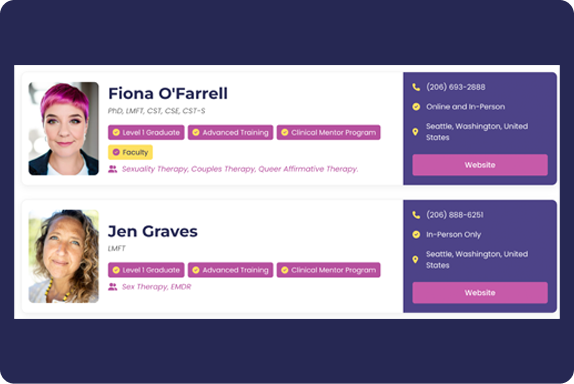
NEW Directory! Get Found By More Couples
Every week, couples and therapists reach out to The Couples Institute® asking for a Developmental ModelTM therapist in their area. Right now, we point them to someone else. When you move into the Advanced Training, we can point them to you.
You can be listed in our therapist directory, where the people searching for this kind of work can find you. We can’t promise a full calendar, and results vary from practice to practice. What we can tell you is that the demand is real and the searches are already happening. If you’d like your name to come up, join the Advanced Group today.
One Reason to
Join Before November 15
Others will have to pay for Solyrais, but not you. As a member of this program, you can use Solyrais for any 3 clients over the next 6 months.
What This Training Is Really For
“In Level 1, it was a lifeline to help me know I can do this. In the Advanced Training, it’s a lifeline to help me know I want to keep doing this.” – Jolyn Sawatzky
That’s it, exactly.
This training is for therapists who love this work and want to go further in it. Who want to become more confident, more differentiated, and more themselves in the room. Who want to develop the kind of clinical instincts that tell them clearly where to go next.
You don’t have to feel ready. You just have to want to keep going.
Frequently Asked Questions
Questions? Email us before you buy — we’re happy to talk through whether this is the right fit for where you are. Ruth@couplesinstitute.com
No. You don’t need to have studied all the material in Level 1. The Advanced Training is for therapists who want to advance their work, not for those who already “feel advanced.”
Level 1 is where you learn the Developmental Model. The Advanced Training is where you integrate it, apply it with more nuance, and make it your own. The group is smaller, the calls go deeper, and you get Pete’s Personal Discovery work (and you retain all Level 1 material).
When you join before November 15, Solyrais is automatically included in your membership. Once you enroll, we’ll be in touch about how to set up your account. You’ll have 6 months to use Solyrais with any 3 couples of your choosing.
The Directory is only for active trainees, so the only way to be listed on the Developmental Model™ directory is by enrolling in the Advanced Group. Once you join, you’ll get an email with a form to fill out so you can be added to the directory.
You don’t have to. Understanding how relationships develop and where they get stuck makes you better with every client, individuals included. Most therapists find the model changes their work with individuals, couples, nonmonogamy, and even family systems.
3 hours a month is enough to get real value. You can watch recordings if you miss live calls. It’s designed to work around a full caseload.
Yes. All sessions are recorded and archived. You won’t fall behind by missing a call.
27 CEs are available after completing 12 months of the program. Details on course objectives and CE requirements are available before you enroll.
Yes. Month to month, no contracts.
Email us within 7 days and we’ll refund your first month. No forms, no hoops, no hard feelings.